


Clearly, not my husband, but it's just for visual effect 😂
Because apparently good clothes and chainsaw grease belong together.
I swear, some people are just magnets for grease and dirt. My husband, for example, has perfectly good work clothes, but somehow the good work clothes are the ones he chooses when it's time to go outside and work on the chainsaw. And my dad? I don't know how he does it, but that man seems to find every greasy, dirty thing within a five-mile radius.
Of course, I can't say too much because I'm just as guilty of getting oil on my own clothes. At Little Prairie Herbal Apothecary, we make oil-based, preservative-free body care products, which means I'm regularly working with infused oils, butters, and beeswax. As much as I love what I do, those ingredients have a remarkable talent for ending up somewhere other than the mixing bowl.
Needless to say, I've got plenty of reasons to appreciate a good stain-removing trick.
I've always liked the idea of keeping household products simple. Not necessarily because everything homemade is better, but because there's something useful about understanding what you're cleaning with and knowing a few tricks that don't require buying a different bottle for every mess.
So let's talk about homemade laundry soap and a few inexpensive things worth keeping in your laundry cupboard.
Making Your Own Laundry Soap
You've probably seen some version of this recipe before. It's been making its way around households for years, and there really isn't much to it.
I like having the option of adding baking soda to the usual combination of grated soap, washing soda, and borax. Each ingredient serves a slightly different purpose, and understanding what they do helps you decide what belongs in your laundry.
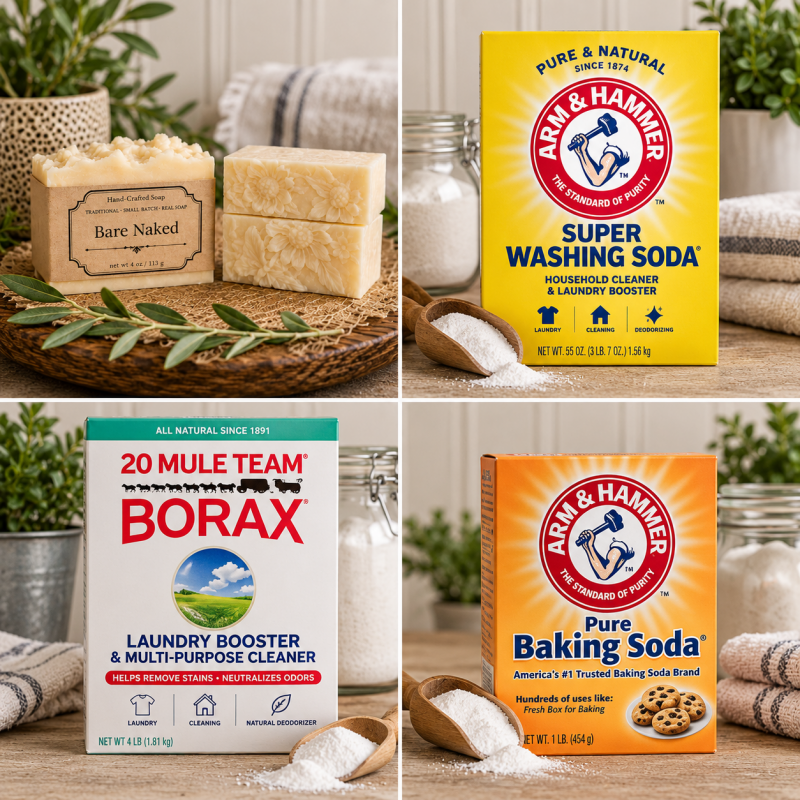
What You'll Need
-
1 bar (approximately 4–5 oz) plain, finely grated soap
-
1 cup washing soda
-
1 cup borax
-
½ cup baking soda (optional)
Putting It Together
-
Grate your bar of soap as finely as possible. A firm, well-cured bar is much easier to work with.
-
In a large bowl, combine the grated soap, washing soda, borax, and baking soda if you're using it.
-
Mix thoroughly until everything is evenly distributed. Try not to stir up a cloud of powder while you're doing it.
-
Transfer the mixture to a dry, airtight container, label it, and keep it away from children and pets.
This is a traditional soap-based laundry mixture, not a modern detergent. It's best reserved for appropriate handwashing or conventional machines that allow soap-based products, using warm or hot water.
For an approved conventional machine, a tablespoon or two per load may be a reasonable starting point, but this particular mixture hasn't been formally tested for dosing or machine compatibility.
And don't worry, we're going to talk about why your washing machine and water type matter before you start making a year's supply.
What Does Each Ingredient Actually Do?
Just because something has been used for generations doesn't mean we shouldn't understand how it works.
Bar Soap
Soap helps loosen oils, grease, and dirt from fabric so they can be carried away with the wash water.
I prefer a simple, firm bar without added moisturizing ingredients when making laundry soap.
Washing Soda
Washing soda, also called sodium carbonate, is a more alkaline ingredient that helps tackle greasy soils and reduces some of the interference caused by hard-water minerals.
It's also a common ingredient in commercial laundry products.
Borax
Borax, or sodium tetraborate, has been used as a laundry booster for generations. It helps create alkaline conditions that can improve cleaning.
It is important to remember that naturally occurring doesn't automatically mean harmless. Borax can irritate the skin and eyes, and you don't want to inhale the powder while mixing it.
Baking Soda
Baking soda is sodium bicarbonate, and while it's related to washing soda, they are not the same thing.
Baking soda is much milder. It can help buffer the wash water and may be useful for managing some odors, although it isn't nearly as effective as washing soda when it comes to tackling heavy grease.
I sometimes include it in my laundry mixture, but it's not an essential ingredient.
Add comment
Comments